How Do You Copyright A.I.?
How Do You Copyright A.I.?
Are you having fun creating works of art using your favorite A.I.? Do you think that your A.I. generated "masterpieces" are worthy of being displayed someday in the Metropolitan Museum of Art? Are you looking forward to selling your beautiful A.I. productions online? Do you have dreams of your A.I.output being published someday in local or national magazines? Are you interacting with A.I. writing assistants to write your "inspired" Magnum Opus, which you know will be purchased by millions of readers from Amazon? How about that A.I. "musical" you are prompting your favorite A.I. CHAT to write and score? You dream of the money that will be rolling in from all your artwork, books, and songs that you and CHATgpt are turning out.
Here is some solid advice you need to understand before you rent a safety deposit box at a local bank to store the money you anticipate earning from your creative prompts you type into your Grok A.I. partner.
Well, here is the bad news!
You cannot copyright art, books, or songs created by A.I. Creative works created entirely by A.I. cannot be copyrighted. Without a copyright on your A.I. created art and writings, and music, you cannot prove the you are the creator of the art. Without a copyright, you can't sell your "winner" to a gallery owner, a publisher, or to a recording company. Without a copyright, none of these businesses will purchase your creative "inspiration."
Well, here is some good news about how you can salvage your artistic rewards
You can still secure a copyright on your creative endeavors, which you produce on your own without expecting A.I. to carry the load. You can still produce art on almost any media –– ceramics, pottery, canvas, posters, short stories, research, and books. In the world of music, you can continue writing yrics and and melodies for guitar, piano, and any instrument. You cannot get a copyright on any work, created entirely by A.I. Neither you nor Grok are entitled to a copyright if all you did was entered a few prompts and Grok painted the picture or wrote the book.
More good news!
There is a solution to this seemingly depressing situation. Remember that creative works produced 100% by A.I. cannot be copyrighted. You cannot change this fact. This rule has been established and is being enforced by the United States Copyright Office. How do you get around this ruling? Where is the loophole?You can partner with A.I. as a co-producer on projects you hope to sell. You have to work TOGETHER with the A.I. of your choice.
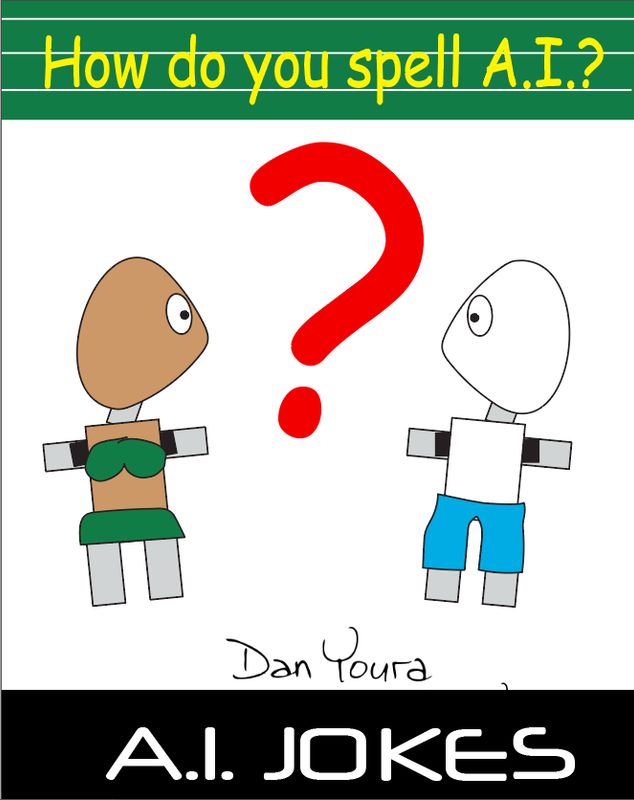
An example. "How Do You Spell A.I.?"
Downloadable file that can be printed out by a desktop printer onto separate sheets of paper. Some cartoon pages are in color. Some are black and white. Not all 50 pages have to be printed or compiled into a book. Any can be printed as single sheets of paper.
When the computer file is kept on the computer or smart phone, the format is designed to enable the capture of individual cartoons/joked to be manipulated and applied in many applications available.
Here are examples of how this work. These are applications to help you navigate these digital and regulatory gymnastics.
I wrote this little book –– How Do You Spell A.I.? I also illustrated the book. It is a playful yet serious collection of jokes and cartoons aimed at the foibles of the A.I. technology in general and more specifically the leaders of the A.I. inductsy. It is playful, yet insightful look at Artificial Intelligence from the point of view of a cartoonist who is also a commentator on current social and political issue. Dan Youra is more than a cartoonist who draws slapstick antics that one might encounter in scenes of the Roadrunner outsmarting Wiley Coyote. Youra if recognized for his satiric art, where in the history of satire he follows in the footsteps of Jonathon Swift and Thomas Nast. The contribution of satire is to point out the short comings witnessed in society, especially among the leaders of society..
In How Do You Spell A.I.? Youra zeros in on the A.I. industrial, raising subtly and not so subtly the questions of many aspects of A.I.'s sudden explosion unto the social and economic scene with all of its hype, hope, and harrowing stories of projected outcomes promised by, or at least, suggested by the high priests, apostles, and acolytes of the A.I religion.
The method used by this talented artist combines cartoons and jokes. 50 one-page art pieces carry the load of message. The final product is technically not a book. The 50 pages are not meant to be bound with staples and glue. Youra designed the single sheet format to enable readers to shuffle the cartoons into other sequences of thought and giving readers the easy and quick was to share the individual art with friends and family. The size of the sheet of paper and the size of the file is 8.5" by 11." The cartoons are designed to be easily seen and grasped when they are posted on the bulletin boards and walls in classrooms and offices. Even on kitchen refrigerators.
Youra says "The cartoons and jokes are meant to be shared." The subject of A.I. is not an easy one for most people to understand. The implementation of A.I. throughout modern society to the extent envisioned by A.I.'s creators, has ramification beyond the impact of computers over the past 50 years. Youra employees two of his characters to carry the message of his satiric humor. Youra drew his, goofy-looking characters with big heads and one eyeball on his computer using Illustrator, a program promoted by Adobe as the graphic tool for artists to create their digital works of art.
Youra declares on one of the first pages in the book that he, not A.I, created his cartoon characters. Even though the content of the book is A.I., Youra sets the record straight that the book is the result of his own brain and creative spirits. So, the question: can Youra secure a registered copyright on his book? Of course he can. This is typical prose and art that has been sanctioned by the US Copyright Office since the beginning of copyright doctrine in the eighteenth century.
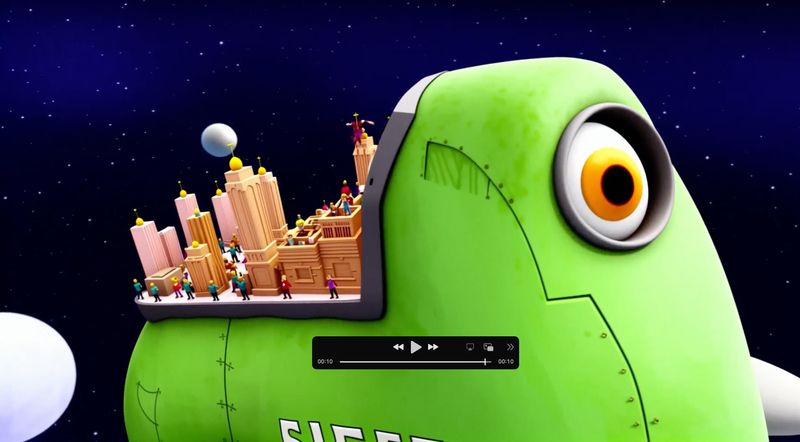
Now, let's take look at an example of another artistic creation of Dan Youra. The work is a series of ten seasonal greeting cards, which he names "Merry Atlas" in recognition of the "Christmas comet"scheduled to travel closest to Earth on December 19, 2025. The similar sounding names Christmas and Atlas gave impetus to the name play. Youra clearly states that A.I. created 100% of the art in the A.I. cards. When you look at the cards, you see the declaration that the artwork in the cards is the result of A.I. having created 100% of the art. The artist does not claim any copyright ownership over the art in the cards. He acknowledges his partnership with A.I. Without a copyright on the work, another artist or publisher can reprint the art work without fear of being challenged by the artist or the publisher. tThe moral to the story is this: if you intend to make money from your creative works, know the regulations and declare your compliance with current law regulating copyright, i.e., the ownership of creativity contributions offered in the marketplace of ideas and art. Now, you can ask "What percentage of the art in question must be recognized as the work of the artist or writer or musician. Good question. We'll look at this and other relevant questions with regard to this new world of creative attribution.
Bottomline: You can't copyright A.I. In the caae of a partnered piece of art between you and A.I.where you are claiming a copyright keep the awareness that even in the partnered production you are not claiming a copyright over the entire work. You are being granted a copyright on "your personal, creative contribution to the final product. Copyrights are granted to human beings, not digital machines. We will cover more on this later in our discussion on the copyright.
Dan Youra
January, 2026